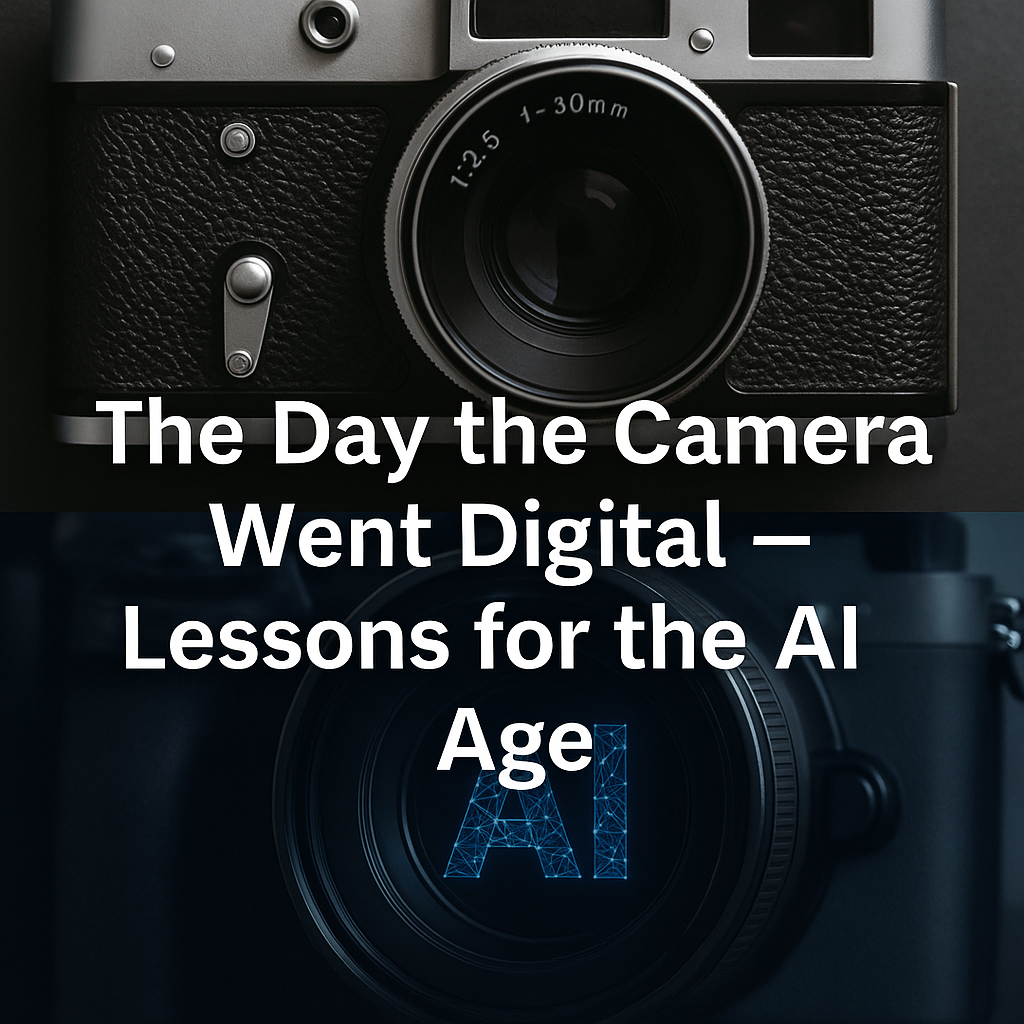
The Day the Camera Went Digital — Lessons for the AI Age
In the 1990s, a quiet but unstoppable revolution began in photography.
For over a century, the rules had been the same. You loaded a roll of film into your camera. You took your shots — careful not to waste them — and when the roll was full, you took it to be developed. Days later, you’d see whether you had captured something brilliant or a blur.
Photography wasn’t just a skill — it was a discipline, an art, and for professionals, a career built on years of learning the craft.
Then came the digital camera.
No film. No darkroom. Instant feedback. Delete the bad shots, keep the good ones, and store thousands on a memory card the size of a postage stamp.
For some, this was a dream come true. For others, it felt like the death of everything they’d mastered.
The Early Reactions: Denial and Opportunity
When the first consumer digital cameras hit the shelves in the mid-1990s, they weren’t perfect. The image quality was low. The colours looked flat. They couldn’t match the depth and richness of film — or so the critics said.
Traditional photographers dismissed them as a gimmick.
“They’ll never replace film,” was the common belief.
But a small number of forward-thinkers saw the writing on the wall. They recognised the convenience, the speed, and the fact that technology improves fast. They learned how to shoot digitally, edit on a computer, and upload images to the emerging world of the internet.
By the early 2000s, their skills were in huge demand.
History’s Harsh Lesson
Those who clung to film-only work watched as their client base shrank.
Newspapers, magazines, and advertisers demanded faster turnaround times and digital delivery. Event photographers found themselves outpaced by those who could shoot and upload photos in hours, not days.
It didn’t matter that film still had its fans — the market had moved on.
Within a decade, the balance had tipped completely. Digital cameras weren’t just as good as film — in many ways, they were better.
The winners were those who saw the change coming and adapted early.
The losers weren’t bad photographers — they were just too slow to change.
The AI Parallel: Déjà Vu in Real Time
Fast-forward to today. We’re living through a revolution just as profound — but this time, it’s not about capturing images. It’s about capturing time, attention, and productivity.
Artificial Intelligence is doing for knowledge work what digital cameras did for photography:
It’s faster.
It’s cheaper.
It’s becoming more capable by the week.
The difference? The AI revolution is moving much faster than the digital shift did. What took photography 10 years to transform could take AI just two or three.
How AI Is Changing the Game Across Industries
Here’s what’s already happening:
1. Marketing and Content Creation
With AI tools like ChatGPT, small businesses can create a month’s worth of social media content in an afternoon. Blog posts, captions, ad copy, and even graphics can be produced faster than ever — freeing up owners to focus on actually running the business.
Case Study:
Imagine a garden room company. Every week, they install 2–3 projects but only have time to post about one. With AI, they can turn all three into polished “Project Spotlight” blogs, complete with captions, before-and-after images, and keyword-rich descriptions. That means more visibility online and more enquiries coming in.
2. Customer Service
Instead of manually replying to every email, AI can draft personalised, friendly responses in seconds. You approve them, hit send, and get back hours of your week.
Example:
A customer asks, “Can you build a garden room under 2.5m to avoid planning permission?”
AI instantly produces a polite, informative reply, complete with a link to your planning page — all ready to send.
3. Sales Support
Quoting used to take hours. Now, AI can help structure a professional proposal in minutes, pulling in your product details, pricing, and customer information automatically.
4. Research and Market Insight
Want to know what your competitors are doing? AI can summarise their websites, analyse their social media, and give you an overview in minutes — helping you spot gaps in the market before they do.
Why Early Adopters Always Win
When digital cameras arrived, the early adopters had years to refine their craft before the rest caught up. That meant they could charge more, attract bigger clients, and lead the conversation.
The same is true now with AI.
The skills you learn today will be commonplace in a few years — but right now, they’re rare and valuable.
If you wait until “everyone’s doing it,” you’re already too late.
Your First AI Steps (You Can Take Today)
Here’s how to start, even if you’ve never used AI before:
1. Start with ChatGPT
Ask it to draft an email, summarise a document, or suggest ideas for a social post. You’ll be surprised how quickly it understands your style.
2. Use Canva’s AI Features
Drop in a photo of a recent project and let Canva suggest ad layouts, flyers, and social media graphics.
3. Explore Image Creation with DALL·E
Need a conceptual image for an ad? DALL·E can create unique visuals in seconds — no stock image fees required.
Why AI Cyclops Is Your Fast Track to AI Mastery
The truth is, you could try to learn AI by yourself — but you’d spend months figuring out which tools to use, how to use them properly, and how to avoid wasting time on features that don’t matter to your business.
At AI Cyclops, we cut through the noise.
In one day, you’ll get hands-on with the tools that work right now — no jargon, no fluff, just practical, immediately usable skills.
We’ll walk you through real examples, help you create live content for your business, and set you up with templates you can use over and over again.
And with 28 days of post-workshop mentoring, you won’t just learn — you’ll apply and see results.
Your Fast Track to AI Confidence
The AI revolution isn’t waiting — and neither should you. The sooner you start, the further ahead you’ll be.
📅 Check our website for the latest dates and locations
🌐 https://theaicyclops.com
📞 01908 382457