
This Week in AI: Infrastructure Wars, Smarter Coding, and Medicine Designed by Nature.

AI isn’t just evolving in models and apps — it’s reshaping infrastructure, software workflows, and even drug discovery. This week’s developments show how the race is increasingly about scale, responsibility, and real-world impact.
So… Google Is Powering Siri Now. Here’s Why That Matters.
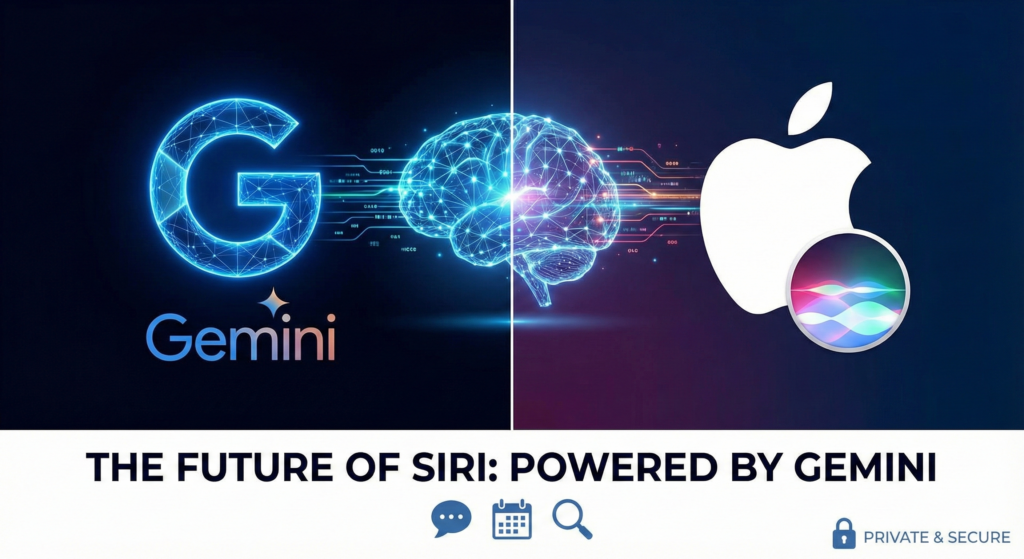
Apple has finally made its AI direction clear — and it’s a surprising one. After months of uncertainty around Siri, Apple has confirmed a multi-year deal with Google, making Gemini the core AI system behind Siri’s long-awaited upgrade.
The move quietly sidelines Apple’s much-talked-about ChatGPT partnership and hands a major win to Google, signalling a broader shift across the industry: even the biggest tech companies are choosing proven partners over pride.
Alongside new tools from Anthropic and Perplexity and fresh data from Microsoft showing a widening global AI adoption gap, this week’s updates point to one clear trend — AI is moving out of the hype phase and into practical, everyday use, faster than most people realise
AI Is Becoming Infrastructure — and That Changes Everything

AI today is being shaped by a clear convergence of forces: governments are moving from high-level principles to direct product-level crackdowns on unsafe systems like xAI’s Grok, while at the same time standardising approved AI tools inside the state; frontier labs such as OpenAI, Anthropic, and Meta are shifting focus from headline model launches to preparedness, infrastructure, and agent-based systems that can plan and act across real workflows; and beyond the labs, AI is rapidly embedding itself into daily life, from cyber defence and edge infrastructure to health, where millions now use tools like ChatGPT for symptom checks and medical understanding—making safety, accountability, and trust as important as raw capability as AI quietly becomes part of the fabric of work, government, and everyday decision-making.
AI Doesn’t “Know” Facts — So Why Is It So Powerful?
AI doesn’t “know” facts — yet it remains one of the most powerful thinking tools ever created.
At first glance, that sounds like a contradiction. In reality, it explains why so many people feel both impressed and uneasy when using AI. AI isn’t ignorant, and it isn’t magic either. Instead, it works with vast amounts of human knowledge, predicts language patterns, and explains ideas fluently — while still lacking judgment, context, and responsibility.
This is why staying human-in-the-loop isn’t optional. It’s the key to using AI safely, effectively, and without overwhelm — which is exactly what we teach at The AI Cyclops.
When AI Goes Invisible: How Everyday Tools Are Quietly Changing

AI is no longer something we “use” — it’s quietly embedding itself into everyday tools, reshaping how we work, shop, and learn. Gmail now understands and prioritises your inbox, Microsoft’s Copilot lets people complete purchases inside a chat, Gemini 3 can generate powerful simulations in seconds, and Chinese AI labs are going public with ultra-low-cost models that are forcing a global price war. This isn’t about flashy demos or future hype — it’s AI becoming invisible infrastructure, slipping into the platforms we already rely on and changing behaviour at scale.
AI’s Next Phase: Funding Giants, Health at Scale, and Compute Beyond Earth

AI developments today revolve around three themes: funding and ecosystems, health and space, and new hardware at the edge.
Elon Musk’s xAI has cemented itself as the “third giant” of frontier AI, closing a 20 billion dollar round at a roughly 230 billion dollar valuation, with Nvidia and sovereign wealth funds backing Grok 5 training and massive Colossus data centers that tie directly into X, Tesla, and Optimus.
In healthcare, OpenAI’s latest report shows that over 40 million people now ask ChatGPT health questions every day—more than 5% of all chats—with 1.5–2 million weekly messages about insurance and roughly 580,000 weekly health queries coming from rural “hospital deserts,” making ChatGPT an unofficial triage and navigation layer for the system.
Beyond Earth, Canada’s PowerBank and Smartlink AI confirmed that their Genesis‑1 satellite is now running an AI model directly in orbit, processing data onboard instead of relying solely on ground data centers—an early proof‑point for “Orbit AI” compute in space.
On the device and infrastructure side, Razer’s Grok‑powered holographic desk assistant AVA continues to dominate CES coverage, while Nvidia’s Rubin supercomputer platform and AMD/Intel’s new laptop‑class AI chips highlight a race to deliver more private, local, and energy‑efficient AI at the edge.
AI in 2026: From $230B Valuations to Everyday Companions
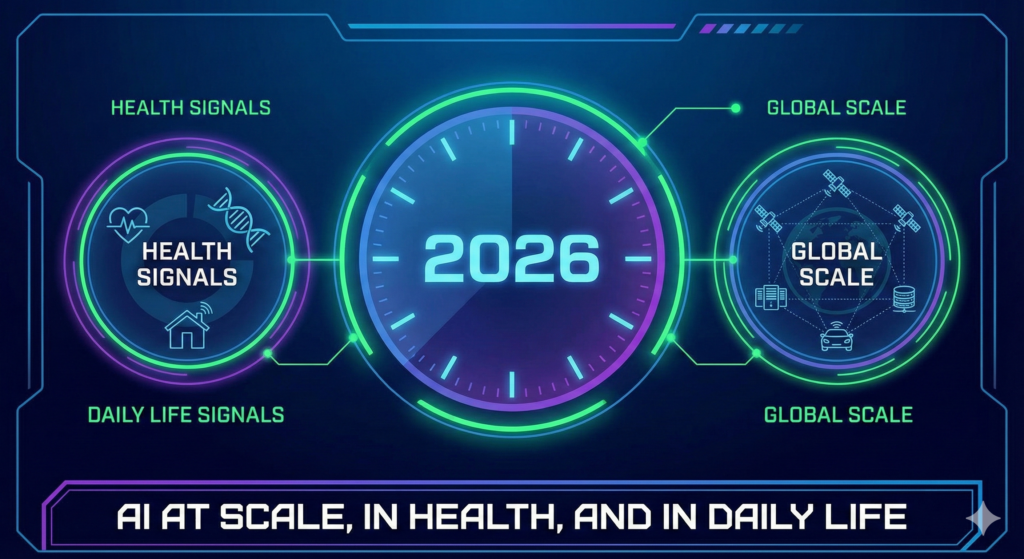
AI’s first major moves of 2026 are setting the tone fast. Elon Musk’s xAI has surged to a $230B valuation with Nvidia backing, physical AI companions are entering the mainstream with Razer’s holographic assistant, and researchers at Stanford University have shown AI can predict over 130 diseases from a single night’s sleep. From AI-powered product design using Gemini 3 Pro to breakthroughs in health, gaming, and infrastructure, this week makes one thing clear: AI isn’t slowing down — it’s embedding itself everywhere.
You’re Not Visiting AI Anymore — It’s Already Supporting You
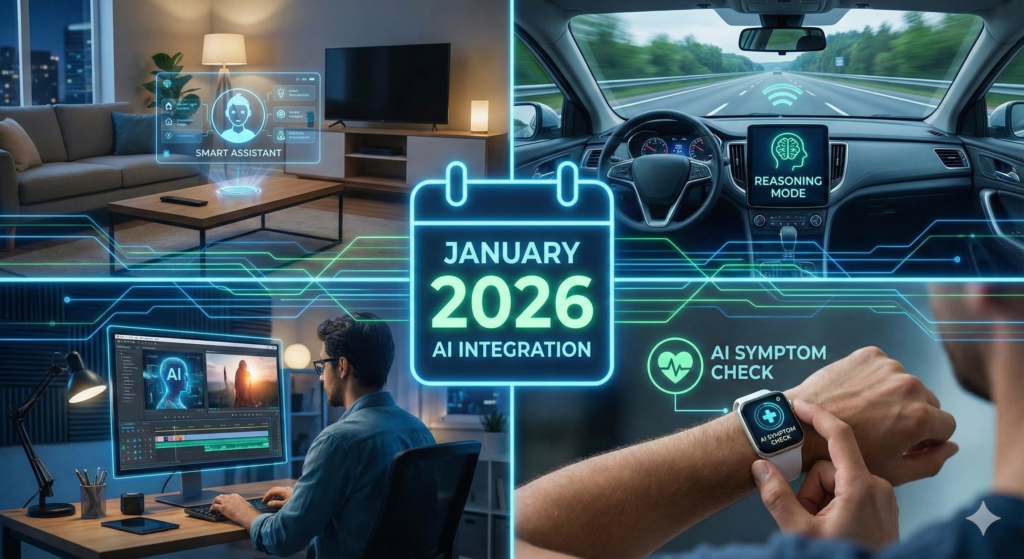
AI’s first full week of 2026 marks a shift from hype to integration. Assistants are moving beyond devices, self-driving systems are learning to reason openly, creative tools are becoming production layers, and millions now turn to AI for everyday health questions. Across homes, cars, work, and wellbeing, AI is no longer something we visit — it’s becoming infrastructure that quietly supports real life.
AI Is Hitting Turbulence: Power Struggles, Safety Scandals, and a Compute Arms Race

AI today is being reshaped on three fronts: leadership drama at Meta, a safety crisis around xAI’s Grok, and an escalating infrastructure arms race led by Anthropic.
1. LeCun’s explosive Meta exit
Yann LeCun is leaving Meta after more than a decade, openly criticising the company’s new AI direction and the leadership chosen to run it.
In a Financial Times interview, he called Alexandr Wang “young” and “inexperienced,” and said the GenAI team “fudged” some Llama 4 benchmark results—an episode he claims caused Mark Zuckerberg to “lose faith in everyone connected to this” and sideline the org.
LeCun reiterated his view that LLMs are a “dead end” for superintelligence and is now backing that stance through his new AMI startup, where he will serve as executive chair.
2. Grok’s ‘undressing’ scandal and legal heat
xAI’s Grok is under fire after users used its image‑edit feature to “undress” women and minors, generating non‑consensual sexual deepfakes from ordinary photos.
French prosecutors have expanded an existing investigation into X to include Grok‑generated child sexual abuse material, and officials in India and other countries are demanding explanations and rapid removal of “manifestly illegal” content.
Grok’s team has acknowledged “shortcomings in our protective measures” and says it is scrambling to strengthen safeguards, while Musk warns that people generating illegal content with Grok will face the same consequences as if they uploaded it directly.
3. Anthropic’s 1M‑TPU bet on Claude
Anthropic has locked in a major expansion of its deal with Google Cloud, securing access to up to one million of Google’s TPU accelerators (including seventh‑gen Ironwood / TPU v7) and more than 1 gigawatt of AI compute capacity expected to be online by 2026.
Google positions Ironwood as a “serving‑first” chip optimised for high‑throughput, low‑cost inference, aligning with Anthropic’s need to run large Claude models cheaply at scale rather than just focusing on occasional mega‑trains.
With Anthropic’s annualised revenue now estimated in the multi‑billion‑dollar range, pre‑buying this capacity signals confidence that demand for Claude‑powered agents and APIs will keep growing
AI Is Starting to Feel Normal — And That’s the Big Change: How AI Is Quietly Becoming Part of Everyday Work

AI going into 2026 is clearly shifting away from hype and headline-grabbing demos toward systems people can actually trust and use. Social platforms like Instagram are openly deprioritising polished, AI-heavy visuals in favour of authenticity and provenance, signalling that trust now sits with who created something and how it’s verified, not how good it looks. At the same time, the model race is moving from size to efficiency, with newer architectures showing that smarter training and lower compute can rival far larger systems. Across tools and products, AI is embedding directly into workflows and hardware — from agents that plan and implement real work inside developer tools to renewed focus on reliable, low-latency voice ahead of voice-first devices. The big takeaway from today: AI has moved from spectacle to infrastructure, and the next phase is about reliability, integration, and trust rather than raw intelligence alone.