
AI Isn’t Replacing Small Business Owners — It’s Giving Them Their Time Back
- AI is not replacing small business owners — it is removing the repetitive tasks that drain your time and energy.
- Tools like ChatGPT and Canva AI require no coding or technical knowledge to use effectively.
- AI can help with emails, social media, meeting summaries, proposals, marketing plans and much more.
- Your personality, judgement and customer relationships are still irreplaceable — AI assists, it does not decide.
- The AI Cyclops runs CPD-certified, hands-on AI workshops in Milton Keynes, starting from £199, designed specifically for everyday business owners.
AI Isn't Replacing Small Business Owners — It's Giving Them Their Time Back
If you run a small business, the chances are you have heard the word AI and felt a flicker of anxiety. Robots taking jobs. Technology taking over. Complicated systems you do not understand. But here is what the headlines rarely tell you: AI for small business owners is not about replacing people — it is about giving you back the hours you spend on tasks that eat into your day before you have even had a coffee.
This post is for the business owner who is doing everything themselves. The one writing emails at 10pm, scrambling for social media ideas on a Sunday, and somehow expected to also run the actual business. AI will not do your job for you — but it can absolutely take the weight off.
Why Small Business Owners Are Running on Empty
Running a small business means wearing every hat. On any given day you might be handling customer enquiries, writing proposals, posting on social media, chasing invoices, planning your next promotion and trying to keep up with your emails — all before lunchtime.
According to the Federation of Small Businesses, there are approximately 5.5 million small businesses in the UK, and the vast majority are owner-operated. That means one person — or a very small team — is responsible for everything from sales to admin to customer service.
The result? Decision fatigue, lost focus and hours spent on tasks that are important but not where your real value lies. This is exactly the problem that AI tools for small business are well-placed to help solve.
AI for Small Business Owners Is Not Just for Tech Experts
One of the biggest misconceptions about AI is that you need to be technical to use it. You do not. You do not need to write code, understand machine learning or have a background in software.
Tools like ChatGPT, Canva AI, Notion AI and Microsoft Copilot are built for normal, everyday users. If you can type a sentence, you can use them. They work by responding to plain-language prompts — you describe what you need, and the tool produces a draft for you to refine.
That is the key word: draft. AI gives you a starting point. It saves you the blank-page paralysis and the time spent on structure and wording. You then apply your knowledge, your tone of voice and your judgement to make it right for your business.
At The AI Cyclops, based in Milton Keynes, workshops are built around exactly this principle. No jargon. No overwhelm. Just practical, hands-on sessions where business owners learn to use these tools step by step — with real examples from their own industries.
You can explore our AI learning programmes for business owners to find out more about what is covered.
The Real Benefit of AI: Getting Your Time Back
Let us get specific. Here is what AI for small business owners can genuinely look like in practice:
- Email campaigns: Instead of spending 45 minutes drafting a promotional email from scratch, you describe your offer to an AI tool and receive a polished draft in under two minutes. You tweak the tone, add your brand voice and send.
- Social media content: Ask an AI tool to generate a week's worth of post ideas based on your product or service. What might have taken a Sunday afternoon now takes ten minutes.
- Proposals and documents: Turn rough notes from a client meeting into a structured, professional proposal — in minutes rather than hours.
- Meeting summaries: Paste your notes or a transcript into an AI tool and receive a clear, concise summary ready to share with your team.
Research from McKinsey & Company suggests that workers using generative AI tools save an average of several hours per week on routine writing and administrative tasks. For a small business owner, that time is not just saved — it is redirected into growth, strategy and the work only you can do.
Want to see what this looks like in a real business context? Take a look at our AI in Action examples to see how other business owners are using these tools day to day.
AI Still Needs the Human Behind It
Here is something worth saying clearly: AI does not replace your expertise, your relationships or your instincts. It cannot know your customers the way you do. It cannot make the judgement call about whether a deal feels right. It cannot bring your years of experience to a difficult conversation.
What AI does is handle the mechanical part of tasks — the drafting, the formatting, the first version — so that you can focus on the part that actually requires a human.
Think of it like having a very capable assistant who is always available and never tired. They can draft the email, pull together the document, suggest ideas for the campaign. But you are still the one who decides what goes out, what the priorities are and how the business should sound.
Your personality, your customer relationships and your business knowledge are still the most valuable things in your company. AI simply helps you carry less of the workload around them.
Practical Examples of AI Tools for Small Business Tasks
To make this as concrete as possible, here is a list of everyday business tasks where AI can add genuine, immediate value:
Marketing and Content
- Social media captions for Instagram, Facebook and LinkedIn
- Blog post ideas and outlines
- Email newsletter drafts
- Website copy for service pages or landing pages
- Video scripts for short-form content or explainer videos
- Marketing plans for new products or seasonal campaigns
Operations and Admin
- Customer FAQ documents
- Staff training materials and onboarding guides
- Meeting summaries and action point lists
- Proposal and quotation templates
- Customer email replies for common enquiries
None of these tasks require technical skill. All of them can be done using free or low-cost AI tools, many of which you can learn in a single workshop session.
How The AI Cyclops Helps Small Business Owners Use AI with Confidence
The AI Cyclops was created specifically for business owners, managers and teams who want to use AI practically — without needing a computer science degree to get started.
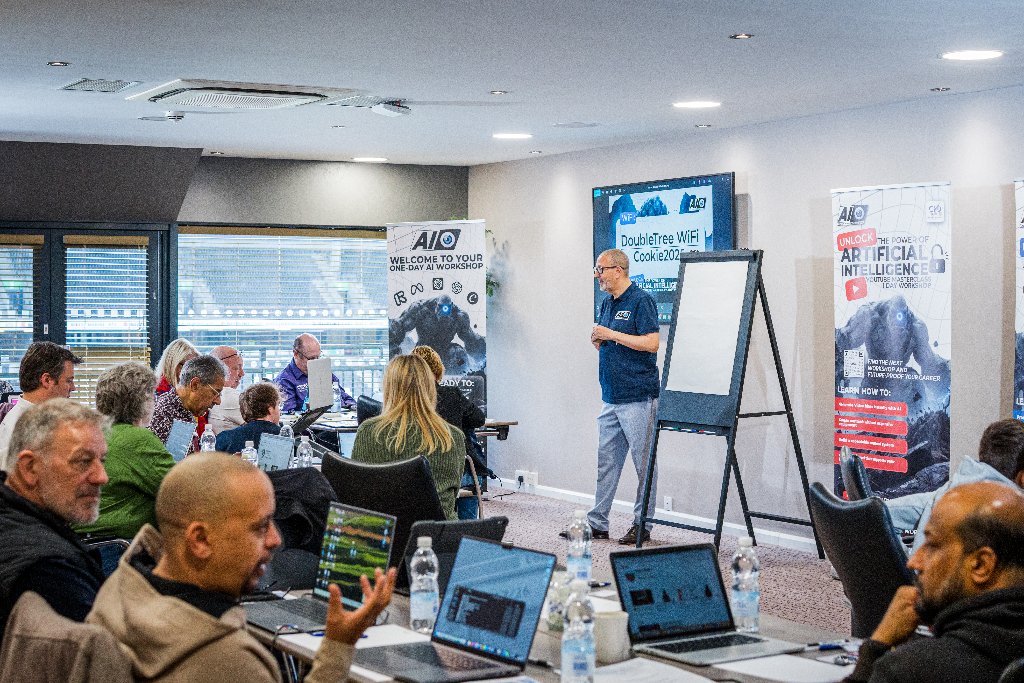
Based in Milton Keynes, The AI Cyclops runs CPD-certified hands-on workshops that walk you through the tools, the techniques and the real-world applications most relevant to your business. Every session is designed around doing, not just listening — so you leave with skills you can apply the very next day.
Workshop options include:
- Standard Workshop — £199: A practical, CPD-certified session covering the core AI tools and how to use them for everyday business tasks.
- VIP Experience — £395: A more in-depth, personalised session with additional support, tailored to your specific business context.
Both options are built around the same principle: no jargon, no overwhelm, just practical skills you can use straight away.
You can book your place on an AI workshop and choose the session that suits your business best.
The UK Government's own AI Sector Deal and associated business guidance highlights the growing importance of AI literacy for businesses of all sizes — making now an ideal time to build those skills.
Frequently Asked Questions About AI for Small Business Owners
Will AI replace small business owners?
No. AI handles repetitive, time-consuming tasks — it does not replace the judgement, relationships and expertise that make a business work. Small business owners remain essential; AI simply reduces the volume of routine work on their plate.
Do I need technical skills to use AI tools?
Not at all. Tools like ChatGPT and Canva AI are built for everyday users and require no coding or technical background. The AI Cyclops workshops in Milton Keynes teach these tools using plain language and real examples — no prior experience needed.
What tasks can AI help a small business with?
AI can assist with writing emails, creating social media captions, summarising meetings, drafting proposals, producing website copy, generating blog ideas, building customer FAQs and planning marketing campaigns — among many other routine tasks.
How much does an AI workshop with The AI Cyclops cost?
The AI Cyclops offers a Standard workshop at £199 and a VIP experience at £395. Both are CPD-certified and hands-on, designed for business owners without a technical background.
How much time could AI realistically save me each week?
Many business owners save between 30 minutes and several hours each week once they start using AI for routine tasks. The exact saving depends on how many areas of the business AI is applied to — but even small savings add up significantly over a year.
Where are The AI Cyclops workshops held?
The AI Cyclops is based in Milton Keynes and runs in-person, CPD-certified AI workshops. Visit the website to see current dates, locations and availability.
From AI-curious to AI-confident in one day.
Join one of our hands-on AI workshops in Milton Keynes. CPD-certified, beginner-friendly, and packed with real outputs you can use the same week.
You might also like

AI Consulting for Small Businesses: Start With the Problem, Not the Tool
Not sure what to automate? The AI Cyclops explains why AI consulting for small businesses should start with the problem — not the platform.
Read more →
Your Website Might Look Fantastic. But Is It Actually Winning You Business?
A beautiful website and one that wins you business are not the same thing. Here's how small businesses can close the gap.
Read more →
The AI Skills Gap: Why Businesses Can't Afford to Wait for the Next Generation
The AI skills gap is growing faster than most UK businesses realise. Practical training — not more software — is the answer.
Read more →